
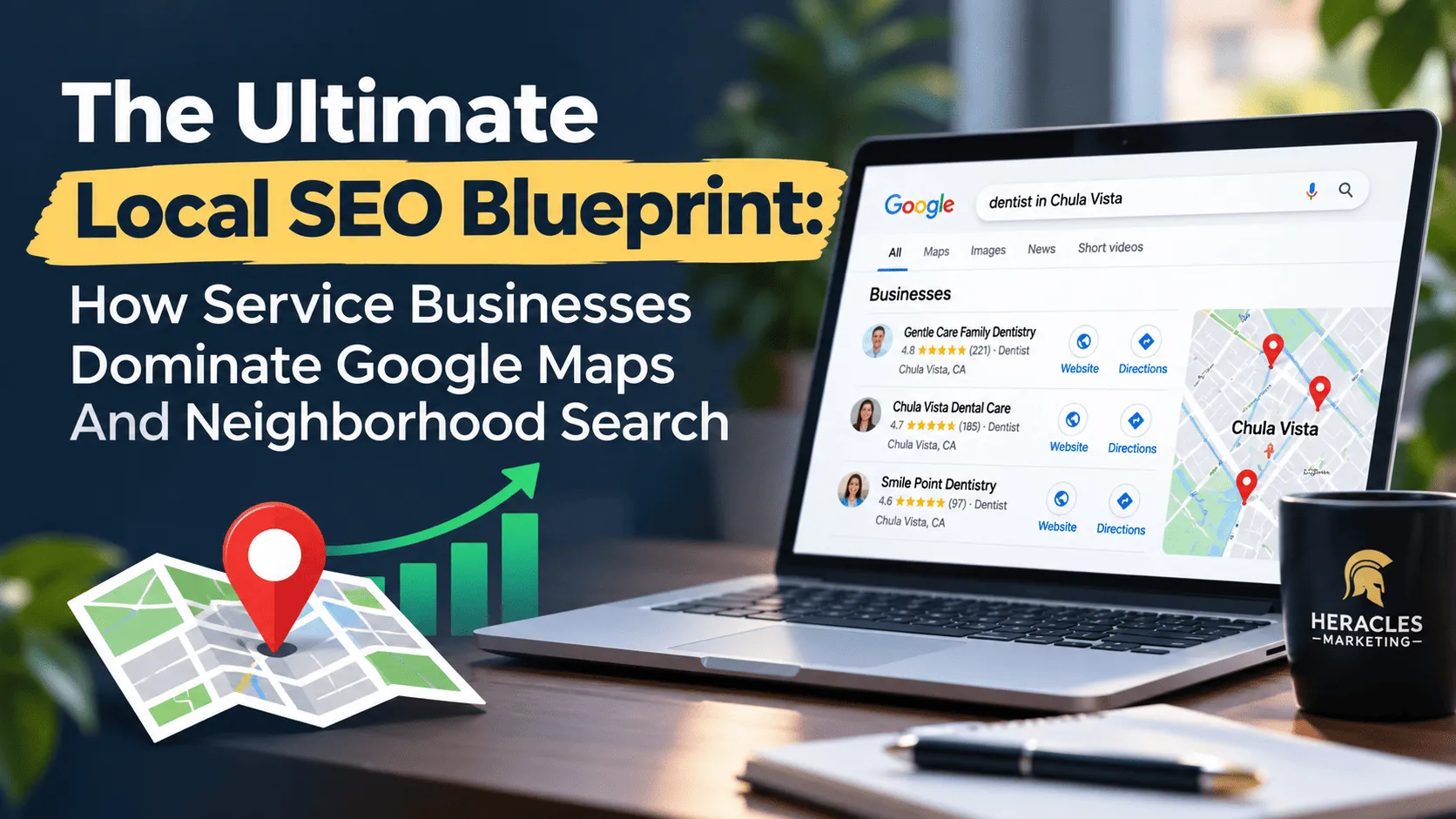
Imagine someone in your city needs an emergency plumber, an electrician, a dentist, or a cleaning company. They pull out their phone, search Google, and look at the businesses appearing in the local results.
They see three or four businesses, compare their reviews, check their locations, and make a decision.
If your business isn’t visible, you probably won’t even be considered.
This is the reality of local search. Customers increasingly use Google to discover nearby businesses, compare service providers, and decide who deserves their money. And while having a website is important, simply owning one doesn’t guarantee that local customers will find you.
You need a strategy that makes your business visible in Google Maps, the local search results, and the neighborhood-specific searches your potential customers perform every day.
That’s where local SEO comes in.
Local SEO is the process of improving your online presence so your business appears when people search for products or services in a particular geographic area. It combines Google Business Profile optimisation, website SEO, local content, reputation management, technical optimisation, and authority building.
When these elements work together, your business becomes easier to discover, easier to trust, and easier to contact.
In this guide, we’ll walk through the complete local SEO blueprint for service businesses looking to attract more customers from their surrounding communities.
How Local SEO Actually Works
Before optimising anything, you need to understand how Google presents local businesses.
When someone searches for a service with local intent, Google may display several types of results.
Google Maps and the Local Pack
The Google Maps results and the local three-pack are among the most valuable placements for businesses serving a specific geographic area.
The local pack typically displays a small selection of businesses alongside information such as:
- Business names and primary categories.
- Customer ratings and reviews.
- Locations and directions.
- Opening hours.
- Phone numbers and website links.
- Other relevant business information.
For example, someone searching for “plumber in Chula Vista” may see several plumbing businesses before the traditional organic search results.
This placement matters because it puts businesses directly in front of people actively looking for a local service.
However, appearing in the local pack isn’t simply a matter of adding your city name to your website or stuffing keywords into your business description.
If your listing is completely missing from the map results, check our diagnostic breakdown of the 10 Reasons Your Business Isn’t Showing Up on the Google Maps 3-Pack to pinpoint and fix the exact blocker.
Google primarily considers three factors when determining local rankings.
-
Relevance: How well your business matches what someone is searching for.
-
Distance: How far your business is from the person searching or the location Google associates with their search.
-
Prominence: How well-known or established your business appears to be, based on signals such as links, reviews, and other information about the business.
These factors work together. A business with an excellent website and hundreds of reviews may still struggle to appear for searches happening far outside its immediate geographic area.
Understanding this distinction is essential because it helps you build a realistic local SEO strategy instead of chasing ranking tricks that cannot overcome geographic limitations.
Traditional Organic Search Results
Local SEO doesn’t stop at Google Maps.
Traditional organic results can include service pages, location pages, local directories, articles, and other relevant websites.
A plumbing company, for example, might appear in the local pack for “plumber near me” while also ranking organically for searches such as:
- Emergency plumbing services in Chula Vista.
- How much does water heater replacement cost?
- Signs you need a sewer line inspection.
- Best time to replace residential plumbing.
These searches represent different stages of the customer journey.
Some people are ready to hire immediately. Others are researching a problem and comparing their options.
A strong local SEO strategy targets both groups.
Now that you know how local SEO actually works, here are 9 steps every local business owner should work through to dominate their local neighborhood search.
1. Build and Optimise Your Google Business Profile
Your Google Business Profile (GBP) is one of the most important assets in local SEO.
It allows your business to appear on Google Search and Maps with information that helps customers discover and contact you.
For many service businesses, it is the first meaningful interaction a potential customer has with the company.
A poorly maintained profile can undermine an otherwise excellent website. Conversely, a complete and accurate profile gives Google and prospective customers better information about your business.
Here’s how to optimise it.
1. Choose the Right Primary Business Category
Your primary category tells Google what your business fundamentally does.
For example:
- A plumbing company should select an appropriate plumbing category.
- A dental practice should select a relevant dental category.
- An electrical contractor should select an electrician category.
- A cleaning company should select a suitable cleaning service category.
Don’t choose categories simply because they contain popular keywords.
Google recommends selecting the most specific categories that accurately describe the business, using as few categories as necessary.
Additional categories can be useful when they genuinely represent the business’s core activities.
The goal is to communicate what your business is, not list everything it happens to offer.
2. Complete Your Business Information
Make sure your profile includes accurate and complete information.
Pay particular attention to:
- Business name.
- Primary and additional categories.
- Physical address, where applicable.
- Service areas.
- Phone number.
- Website.
- Regular operating hours.
- Special and holiday hours.
- Business description.
- Relevant attributes.
Consistency is important. Your business information should agree with what customers see on your website, signage, and other reputable business listings.
Don’t add unnecessary keywords to your business name. Google’s guidelines require the name to reflect how the business is genuinely represented in the real world.
3. Add Your Services
Your Google Business Profile can display individual services, depending on the business category and available profile features.
For a dental practice, these might include:
- Dental implants.
- Teeth whitening.
- Dental crowns.
- Emergency dentistry.
- Invisalign.
For a plumbing business:
- Drain cleaning.
- Water heater installation.
- Leak detection.
- Pipe repair.
- Emergency plumbing.
Adding relevant services helps prospective customers understand what you offer.
It also creates an opportunity to make your profile more informative and useful.
However, don’t list services you don’t actually provide. Accuracy is more important than trying to associate your business with every conceivable search term.
4. Write a Useful Business Description
Your business description should explain:
- What your business does.
- Who it serves.
- Which services it specialises in.
- What makes it worth considering.
For example:
ABC Plumbing provides residential and commercial plumbing services throughout Chula Vista and surrounding communities. Our services include emergency plumbing, leak detection, drain cleaning, water heater installation, and general plumbing repairs. We help homeowners and businesses resolve plumbing problems with professional service and practical solutions.
This is more useful than repeating variations of “best plumber in Chula Vista” several times.
Write for customers first.
5. Upload Quality Photos and Videos
Photos give customers a better understanding of your business before they contact you.
Depending on your industry, consider uploading:
- Exterior and interior photos.
- Team photographs.
- Staff working on actual projects.
- Completed installations.
- Before-and-after photographs.
- Equipment and vehicles.
- Products and completed work.
For service-area businesses, genuine photographs of completed projects can be particularly valuable.
A cleaning company can show completed commercial cleaning projects. A landscaper can showcase transformed gardens. A contractor can demonstrate completed renovations.
Use genuine, relevant photographs rather than generic stock images.
6. Keep Your Profile Active and Accurate
Regularly review your profile to ensure the information remains current.
Respond to customer questions where available, maintain accurate hours, add relevant updates, and replace outdated photographs.
You don’t need to publish daily just to keep a profile active. Focus on providing useful information and maintaining an accurate representation of the business.
2. Find the Right Local Keywords
Keyword research for local businesses is different from keyword research for national websites.
A service business doesn’t necessarily need to attract thousands of visitors from across the country. It needs to attract people who can realistically become customers.
That means geographic relevance and commercial intent matter enormously.
Start With Your Core Services
List the services your business actually provides.
A dental practice might offer:
- General dentistry.
- Dental implants.
- Cosmetic dentistry.
- Teeth whitening.
- Invisalign.
- Emergency dental care.
A cleaning company might offer:
- Residential cleaning.
- Commercial cleaning.
- Office cleaning.
- Deep cleaning.
- Move-in and move-out cleaning.
- Post-construction cleaning.
Each service represents a potential search opportunity.
Add Geographic Modifiers
Next, combine your services with relevant geographic terms.
For example:
| Core service | Local keyword |
|---|---|
| Plumbing | Plumber in Chula Vista |
| Drain cleaning | Drain cleaning Chula Vista |
| Dental implants | Dental implants in Chula Vista |
| Office cleaning | Office cleaning in Chula Vista |
| HVAC repair | HVAC repair near Chula Vista |
You should also investigate how customers search within individual neighborhoods and nearby communities.
For example:
- Plumber in Eastlake.
- Dentist near Otay Ranch.
- Office cleaning in Bonita.
- Electrician in National City.
These searches can reveal opportunities that broad city-level keyword research misses.
Understand Search Intent
Not all local searches indicate the same level of buying intent.
Consider these examples:
Informational searches:
- Why is my water heater leaking?
- How long do dental implants last?
- How often should an office be professionally cleaned?
Commercial investigation searches:
- Best dentists in Chula Vista.
- Top-rated commercial cleaning companies.
- Dental implant specialists near me.
Transactional searches:
- Emergency plumber Chula Vista.
- Book dentist appointment Chula Vista.
- Commercial cleaning company near me.
Prioritise searches that closely align with your services and customer acquisition goals, while building supporting content for people earlier in the decision-making process.
Use More Than Keyword Search Volume
A keyword with 100 monthly searches can be more valuable than one with 5,000 searches if it represents a much stronger buying opportunity.
Consider:
- How closely the search matches your service.
- Whether the searcher is likely to hire someone.
- The geographic area involved.
- The value of a typical customer.
- The competition for that search.
- Whether you can realistically serve the location.
A commercial roofing contractor might prioritise “commercial roof replacement contractor” over a broad search such as “roofing.”
The first search may attract fewer people, but those people could represent much more valuable opportunities.
3. Dominate Neighborhood Searches With Geographic Relevance
One of the biggest mistakes service businesses make is treating their entire service area as a single market.
A company might serve an entire city, but customers search from different neighborhoods, suburbs, and surrounding communities.
Google’s local results also vary depending on where the search takes place.
This means a business can rank well close to its address but become significantly less visible several miles away.
Understand Your Local Search Geography
Start by identifying the areas you genuinely serve.
For example, a dental practice in Chula Vista might attract patients from:
- Eastlake.
- Otay Ranch.
- National City.
- Bonita.
- San Ysidro.
A plumbing company might serve several surrounding communities within a reasonable driving distance.
Don’t assume that listing these locations on your website will automatically make you rank in all of them.
Distance remains an important local ranking factor.
Your job is to build genuine relevance and visibility in the locations where you can actually serve customers.
On the flip side, misconfigured service areas, broad match ad settings, or ambiguous location signals can attract unqualified leads from outside your coverage zone - see our guide on 9 Reasons Your Business Gets Out-of-State Phone Calls (And How to Fix Them) to learn how to tighten your geographic targeting.
Create Location Pages With a Purpose
Location pages can help businesses explain their services in the context of specific geographic markets.
For example:
/areas-we-serve/chula-vista//areas-we-serve/eastlake//areas-we-serve/bonita/
But creating dozens of nearly identical pages with nothing more than a changed city name is not a sustainable strategy.
Each location page should provide meaningful, location-specific information.
Include:
- The services available in that area.
- Relevant information about the local market.
- Real examples of work completed nearby, where available.
- Customer testimonials from that area, with permission.
- Relevant photographs.
- Clear contact and enquiry options.
- Links to the appropriate service pages.
A landscaping company could use a location page to showcase projects completed in Eastlake, discuss common landscaping considerations in that community, and explain which services are available to local homeowners.
That provides genuine value.
Don’t Create Fake Business Locations
Some businesses try to rank in multiple neighborhoods by creating additional Google Business Profiles using virtual offices, rented addresses, or locations where they don’t genuinely operate.
This is risky and can violate Google’s guidelines.
If your business travels to customers, configure it as a service-area business where appropriate.
Google allows eligible service-area businesses to define the areas they serve without publicly displaying their residential or office address.
You should represent your actual operations rather than manufacture locations to manipulate search results.
4. Make Your Service Pages Turn Searches Into Customers
Your website is where local visibility should translate into business enquiries.
A Google Business Profile might generate impressions, website visits, calls, and direction requests. But if your website doesn’t explain your services or make contacting you easy, you’re losing opportunities.
One of the most common local SEO problems is a website with a single generic services page attempting to rank for multiple unrelated treatments or services.
A better approach is to build dedicated pages around your most important services.
Give Every Important Service Its Own Page
Suppose you run a dental practice.
Rather than placing every treatment on one page, consider creating dedicated pages for:
- Dental implants.
- Invisalign.
- Teeth whitening.
- Dental crowns.
- Emergency dentistry.
Each page should explain the specific treatment, answer common questions, establish credibility, and encourage prospective patients to take the next step.
The same principle applies to other industries.
A plumbing company could create individual pages for water heater installation, drain cleaning, leak detection, and emergency plumbing.
This creates clearer topical relevance and gives each service a dedicated destination for organic search traffic.
Optimise Each Service Page
A strong service page should include:
A clear page title: Describe the service and, where appropriate, the location.
A compelling introduction: Explain what the service involves and who needs it.
Detailed service information: Describe the process, benefits, limitations, and relevant considerations.
Trust signals: Include genuine testimonials, qualifications, certifications, photographs, and relevant experience.
Frequently asked questions: Answer the questions prospective customers commonly ask.
A clear call to action: Make it easy to call, request a quote, book an appointment, or submit an enquiry.
For example, a page targeting dental implants in Chula Vista should explain the treatment, who may be a suitable candidate, the consultation process, and how prospective patients can arrange an appointment.
Avoid writing pages that simply repeat a keyword without providing useful information.
Make Mobile Conversion a Priority
Local searches frequently happen on mobile devices.
A potential customer might be standing outside their home with a burst pipe, looking for an emergency plumber. A patient might be searching for a nearby dentist during a lunch break.
Your website needs to make the next step obvious.
Prioritise:
- Fast page loading.
- Readable typography.
- Clear navigation.
- Click-to-call phone numbers.
- Visible appointment or quote buttons.
- Simple enquiry forms.
- Easy access to important service information.
A technically impressive website that makes it difficult to contact the business is not doing its job.
5. Reviews - Build A Strong and Consistent Local Reputation
Reviews influence how customers perceive your business and can contribute to local prominence.
A business with a strong collection of genuine, detailed reviews may be more attractive to prospective customers than a competitor with very little customer feedback.
Reviews are therefore an important part of local SEO and customer acquisition.
Build a Consistent Review Generation Process
Don’t wait for customers to leave reviews spontaneously.
Make asking for feedback part of your normal customer experience.
For example:
- Complete the customer’s service.
- Confirm that they are satisfied with the work.
- Send a polite follow-up message.
- Include a direct link to your Google review page.
- Thank them for taking the time to share feedback.
The process should be natural and consistent.
Don’t buy reviews, fabricate testimonials, or offer incentives in exchange for positive ratings. Ask customers for honest feedback without attempting to influence their opinions.
Respond to Positive and Negative Reviews
Responding to reviews demonstrates that your business takes customer feedback seriously.
For positive reviews, thank the customer and acknowledge their experience.
For negative reviews, remain professional.
Avoid arguing, revealing private customer information, or becoming defensive.
If the complaint is legitimate, acknowledge the concern and provide an appropriate way to resolve it.
If a review appears fake or violates Google’s policies, use the appropriate reporting process. Don’t assume that every negative review can be removed simply because you disagree with it.
or a step-by-step response framework and escalation workflow, read our guide on How to Handle a 1-Star Google Review Before It Kills Your Local Rankings.
Look Beyond Your Overall Rating
A five-star rating is useful, but the quality and context of reviews matter too.
Pay attention to:
- Review recency.
- Review consistency.
- Detailed customer experiences.
- Recurring service mentions.
- The way the business responds.
- Feedback about specific aspects of the customer experience.
Reviews can also reveal operational weaknesses.
For example, repeated complaints about missed appointments or poor communication may indicate problems that marketing alone cannot fix.
Local SEO can generate more enquiries, but the business still needs to deliver a good customer experience.
6. Build Your Local Authority With Citations and Links
Google needs to understand that your business is a legitimate, established entity.
Your website, Business Profile, business directories, industry websites, local publications, and other online references can all contribute to your broader digital presence.
Two important parts of this process are local citations and link building.
Build Accurate Local Citations
A local citation is an online mention of your business’s identifying information, typically including its name, address, and phone number.
Citations can appear on:
- Business directories.
- Industry-specific directories.
- Local chamber of commerce websites.
- Professional association websites.
- Local business networks.
- Relevant community websites.
Prioritise accurate and relevant listings rather than submitting your business to hundreds of low-quality directories.
Make sure your business information is consistent, particularly:
- Business name.
- Address.
- Phone number.
- Website.
- Primary business category.
If your business moves or changes its phone number, update important listings rather than allowing conflicting information to accumulate.
Earn Relevant Local Backlinks
Backlinks are links from other websites pointing to yours.
They can help search engines discover your website and understand its authority and relevance.
For local businesses, relevant links can come from:
- Local news publications.
- Community organisations.
- Industry associations.
- Local business partnerships.
- Sponsorships and community events.
- Relevant professional directories.
- Suppliers and business partners.
For example, a local roofing contractor might earn a link from a community publication after completing a charitable roofing project.
A dental practice could receive a relevant mention from a local health organisation.
Focus on earning links that make sense for your business rather than purchasing large quantities of unrelated backlinks.
Develop a Local PR Strategy
Digital PR gives businesses opportunities to earn exposure beyond traditional SEO activities.
Consider:
- Sponsoring local community events.
- Participating in charitable initiatives.
- Publishing useful local research.
- Contributing expert commentary to local publications.
- Partnering with complementary businesses.
- Sharing genuinely newsworthy company developments.
The objective is to create reasons for relevant websites and organisations to mention your business.
These activities can strengthen your reputation while supporting your broader SEO strategy.
7. Strengthen Your Website’s Technical SEO
A strong local SEO strategy requires a website that search engines can crawl, understand, and index.
You don’t need an unnecessarily complicated technical setup, but you do need to eliminate problems that prevent important pages from performing properly.
Fix Indexing and Crawlability Issues
Start by checking whether Google can access your important pages.
Use Google Search Console to investigate:
- Pages that aren’t indexed.
- Crawling errors.
- Unexpected exclusions.
- Redirect problems.
- Duplicate URLs.
- Sitemap issues.
Submit an XML sitemap containing your important canonical URLs.
Make sure your service pages and location pages are accessible through internal links rather than existing as isolated URLs.
Improve Page Speed and Core Web Vitals
Page performance affects the user experience.
Pay particular attention to:
- Largest Contentful Paint (LCP).
- Interaction to Next Paint (INP).
- Cumulative Layout Shift (CLS).
Common performance improvements include:
- Compressing and resizing images.
- Using modern image formats.
- Reducing unnecessary JavaScript.
- Implementing appropriate caching.
- Reserving space for images and other dynamic elements.
- Improving server response times.
A fast website makes it easier for visitors to explore your services and contact your business.
Implement Local Business Structured Data
Structured data helps search engines understand information about your business.
For eligible local business pages, Schema.org markup can communicate details such as:
- Business name.
- Address.
- Phone number.
- Website.
- Opening hours.
- Geographic coordinates.
Use the most specific supported business type that accurately describes your organisation.
For example, a dentist might use an appropriate dental business type, while a plumbing company can use a relevant local business type.
Make sure the information in your structured data matches the visible content on your website.
Structured data does not guarantee better rankings or special search features, but it can help Google understand your business information.
Validate your markup and monitor the results after implementation.
Strengthen Internal Linking
Internal links connect related pages on your website.
For example:
- Your homepage should link to important service pages.
- Your service pages should link to relevant supporting articles.
- Your location pages should link to services available in those areas.
- Your blog articles should link to relevant commercial pages.
This creates a clearer website structure and helps visitors discover related information.
It also helps search engines understand the relationships between your pages.
8. Create Local Content That Attracts Customers
Publishing generic blog articles isn’t enough to build a meaningful local content strategy.
Your content should address the questions, concerns, and problems your potential customers actually have.
Think about the information someone needs before choosing your service.
A dental practice could publish:
- How Much Do Dental Implants Cost in Chula Vista?
- What to Expect During Your First Dental Implant Consultation.
- Dental Implants vs. Dentures: Which Option Is Right for You?
- When Should You See an Emergency Dentist?
A plumbing company could publish:
- Why Does My Water Heater Keep Losing Hot Water?
- How Much Does Drain Cleaning Cost in Chula Vista?
- Signs Your Home May Have a Hidden Water Leak.
- When Should You Replace Your Water Heater?
These articles serve different search intents while supporting the business’s main service pages.
Build Topic Clusters Around Your Services
A topic cluster consists of a central pillar page supported by more focused articles covering related subjects.
For example, a local SEO cluster might include:
Pillar page: The Ultimate Local SEO Blueprint: How Service Businesses Dominate Google Maps and Neighborhood Search.
Supporting articles:
- How to Optimise Your Google Business Profile for Local Rankings.
- How to Find and Fix Google Maps Ranking Problems.
- How to Build Location Pages That Actually Rank.
- Local Keyword Research: Finding High-Intent Searches in Your Service Area.
- How to Get More Google Reviews Without Violating Google’s Guidelines.
- Local Citations: How to Build Consistent Business Listings.
- Why Your Business Isn’t Showing Up on Google Maps.
- How to Track Local SEO Rankings Across Multiple Neighborhoods.
Each supporting article should explore its subject in greater depth and link back to the pillar page where relevant.
This creates a connected content resource rather than a collection of unrelated blog posts.
Demonstrate First-Hand Experience
Local content becomes more valuable when it reflects real business knowledge.
Include:
- Original photographs.
- Real project examples.
- Customer experiences, with permission.
- Practical advice from industry professionals.
- Local observations.
- Clear explanations of common problems.
Avoid creating hundreds of generic location articles with identical content and substituted city names.
Your objective should be to become a genuinely useful resource for the communities you serve.
9. Track Local SEO Performance Properly
One of the biggest mistakes businesses make is measuring local SEO exclusively through rankings.
Rankings matter, but they don’t tell you whether your marketing is generating business.
A successful local SEO campaign should improve visibility while also generating meaningful customer actions.
Track Google Business Profile Performance
Monitor available Business Profile performance metrics, including:
- Searches that surfaced your profile.
- Profile views.
- Website clicks.
- Phone calls.
- Direction requests.
- Other available customer interactions.
These metrics help you understand how people interact with your listing.
However, an increase in profile views doesn’t automatically mean an increase in customers.
Monitor Neighborhood-Level Rankings
Local rankings vary depending on where the search takes place.
Checking your ranking from one computer in one location doesn’t give you a complete picture of your visibility.
Use a local rank-grid tool to examine how your business performs across a geographic area.
For example, a grid might show that your plumbing company ranks strongly around its physical location but has limited visibility in surrounding neighborhoods.
Track relevant searches separately:
- Plumber near me.
- Emergency plumber.
- Drain cleaning.
- Water heater repair.
Repeat the measurements periodically using comparable locations and search terms.
Remember that a map grid is a visibility measurement, not a direct measure of leads or revenue.
Track Website Performance in Google Search Console
Google Search Console can help you understand which searches generate impressions and clicks for your website.
Look at:
- Queries containing service names.
- Queries containing city and neighborhood names.
- Pages receiving local organic traffic.
- Changes in impressions and clicks.
- Pages with high impressions but relatively low click-through rates.
Use this information to identify opportunities for improved content, titles, internal linking, and page relevance.
Measure Actual Leads and Revenue
Ultimately, the most important question is whether local SEO is helping the business grow.
Track:
- Qualified enquiries.
- Phone calls.
- Appointment bookings.
- Quote requests.
- Lead-to-customer conversion rate.
- Customer acquisition cost.
- Revenue generated from organic search.
Where possible, use call tracking and form attribution to understand which marketing channels generate enquiries.
A campaign that increases rankings but generates no meaningful business outcomes needs further investigation.
A Practical 90-Day Local SEO Implementation Plan
Local SEO is not a one-time checklist. It requires consistent optimisation, measurement, and improvement.
Here’s a practical roadmap for service businesses that want to build a stronger local presence.
Days 1–30: Establish the Foundation
Focus on fixing the most important structural issues.
Google Business Profile
- Claim and verify the profile.
- Review the primary and additional categories.
- Complete business information.
- Add accurate services.
- Upload genuine photographs.
- Review opening hours and service areas.
Website
- Audit indexing and crawlability.
- Review important service pages.
- Fix major technical SEO issues.
- Check mobile usability and page performance.
- Implement appropriate local business structured data.
Research
- Identify core services.
- Research local and neighborhood keywords.
- Analyse local competitors.
- Establish baseline rankings using a map grid.
- Review existing leads and conversion data.
Days 31–60: Build Relevance and Authority
Start expanding your local search footprint.
- Improve existing service pages.
- Create missing high-priority service pages.
- Develop useful location pages where justified.
- Build a consistent review request process.
- Correct important business citations.
- Identify relevant local link opportunities.
- Publish supporting local content.
- Strengthen internal linking.
At this stage, prioritise quality over the number of pages or links produced.
Days 61–90: Measure, Refine and Expand
Use actual performance data to decide what to improve next.
- Review Google Business Profile performance.
- Compare map-grid visibility with the initial baseline.
- Analyse Search Console queries.
- Identify service pages with growing impressions.
- Improve pages that attract impressions but few clicks.
- Review the quality of incoming leads.
- Expand content around demonstrated opportunities.
- Continue earning relevant local mentions and links.
Don’t expect every business to reach the local three-pack within 90 days. Competition, proximity, existing authority, and the starting condition of the website all influence how quickly results develop.
The objective of this period is to establish a measurable improvement process and build a stronger foundation for sustained growth.
What Are The Most Common Local SEO Mistakes That Hold Businesses Back?
Even businesses that invest in SEO can undermine their results through avoidable mistakes.
Here are some of the most common problems.
Keyword Stuffing the Google Business Profile Name
Adding phrases such as “Best Emergency Plumber Chula Vista” to a business name that doesn’t use that name in the real world can violate Google’s guidelines.
Use the genuine business name and place relevant information in the appropriate profile fields.
Creating Duplicate or Fake Business Locations
Creating multiple profiles at virtual offices or locations where the business doesn’t genuinely operate can result in profile suspensions or other issues.
Represent your actual business locations accurately.
Publishing Thin Location Pages
Creating dozens of pages with identical content and different city names does not establish meaningful local relevance.
Every location page should provide useful, distinct information.
Ignoring Reviews
A business that consistently receives customer feedback but never responds misses an opportunity to demonstrate that it values its customers.
Build a sustainable review management process.
Focusing Exclusively on Rankings
A business can achieve better visibility without generating more revenue.
Track qualified leads, calls, appointments, and actual customer acquisition alongside rankings.
Neglecting the Website
Your Google Business Profile and website work together.
A well-optimised profile cannot compensate for a website with confusing navigation, poor service pages, or no clear way to contact the business.
Local SEO Is a Customer Acquisition System, Not Just a Ranking Exercise
The businesses that benefit most from local SEO understand that visibility is only the beginning.
Getting your business in front of potential customers is important, but it is only one part of the process.
You also need to communicate why someone should choose you, establish credibility, explain your services, and make it easy for them to take action.
Think of local SEO as a connected customer acquisition system:
- Discovery: Your Google Business Profile and website appear for relevant searches.
- Consideration: Your reviews, photographs, service information, and content help customers evaluate your business.
- Conversion: Your website, phone number, booking system, and enquiry forms make it easy to contact you.
- Retention: A positive customer experience encourages repeat business, referrals, and genuine customer feedback.
Each stage supports the next.
A business that invests only in rankings while ignoring its website and customer experience is leaving much of its marketing potential untapped.
Final Thoughts: Build a Local Presence That Generates Business
Local SEO is one of the most valuable long-term marketing investments available to service businesses.
When implemented properly, it helps customers discover your services, evaluate your business, and contact you when they need what you offer.
But sustainable local visibility doesn’t come from a single optimisation trick.
It comes from building a complete online presence: an accurate Google Business Profile, useful service pages, relevant local content, genuine customer reviews, credible local authority, and a website designed to convert visitors into enquiries.
Start by understanding how your business currently appears in Google Search and Maps. Identify the services and neighborhoods where you have the greatest growth opportunities. Fix the foundational issues, then build on that progress through consistent optimisation and measurement.
And remember: the goal isn’t simply to rank higher on Google.
It’s to become the business local customers find, trust, and choose.
Frequently Asked Questions About Local SEO
What is local SEO?
Local SEO is the process of improving a business’s visibility in location-based searches on Google and other search engines. It involves optimising your Google Business Profile, website, local content, reviews, citations, and other online signals to attract customers in your service area.
How long does local SEO take to produce results?
There is no universal timeline. Some improvements can influence how customers interact with your business relatively quickly, while meaningful organic and local ranking improvements may take several months. Competition, proximity, website quality, existing authority, and the amount of work required all affect the timeline.
How do I rank higher on Google Maps?
Start by verifying and completing your Google Business Profile, selecting accurate categories, maintaining consistent business information, adding relevant services, collecting genuine customer reviews, and building a useful website. Improve your overall prominence and relevance while recognising that you cannot directly control the distance between your business and the searcher.
Does my business need a physical address to rank locally?
Not necessarily. Eligible service-area businesses can create Google Business Profiles without publicly displaying their address, provided they meet Google’s eligibility requirements. They should configure their service areas accurately and must not use virtual offices as fake business locations.
How important are Google reviews for local SEO?
Reviews contribute to customer trust and are one of the signals associated with local prominence. Genuine, detailed feedback can help prospective customers evaluate a business. Make review requests part of your normal customer experience, and respond professionally to both positive and negative feedback.
Do I need a separate page for every city I serve?
No. Create location pages when you can provide genuinely useful, distinct information about your services in those locations. Avoid producing large numbers of near-identical pages that exist primarily to target different city names.
What is the difference between local SEO and traditional SEO?
Traditional SEO generally focuses on improving visibility across broader organic search results. Local SEO focuses on searches with geographic intent and the customers a business can serve in specific locations. The two overlap significantly, particularly when optimising service pages, technical SEO, content, and backlinks.
Can a business rank in Google Maps without a website?
Yes. An eligible, verified Google Business Profile can appear in Google Maps without a dedicated website. However, having a useful website provides additional opportunities to explain services, establish credibility, attract organic traffic, and convert prospective customers.
What is a local SEO map grid?
A local SEO map grid is a visual representation of a business’s rankings across multiple geographic points within a selected area. It helps identify where a business has strong or weak visibility for specific searches. Results vary by keyword, search location, and measurement conditions, so grid reports should be treated as diagnostic snapshots rather than guaranteed rankings.
What should a local SEO campaign measure?
Track Google Business Profile interactions, website organic traffic, local keyword visibility, map-grid rankings, qualified calls, enquiry submissions, bookings, and revenue. The most useful metrics connect search visibility to actual business outcomes.